

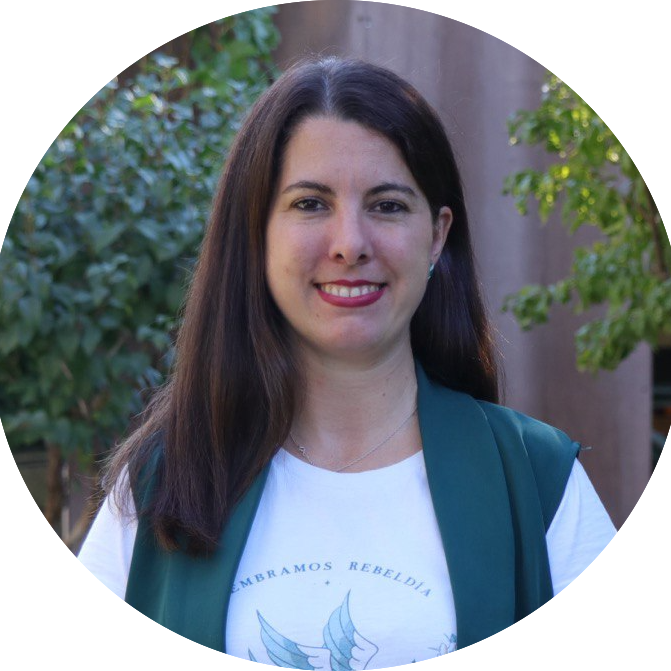
Naiara Larrakoetxea, Bachelor in Political Science, Specialist in Basque Studies and Master in Governance and Political Studies, is currently a researcher at the UPV-EHU, where she is doing her PhD in Society, Politics and Culture program, analyzing the deaf community from a political science perspective. Being Basque ignited her interest in understanding the complexities of political conflicts and their profound impact on relationships and social structures. These experiences ingrained in her a deep appreciation for democratic values and the importance of fostering dialogue across differences. Her commitment to politics has led her to hold different political positions in deaf associations in Spain and Basque Country for a decade, especially those related to Spanish Sign Language policy.
Building on a decade of experience in regional and national positions focused on language rights, I have engineered a research focusing on Deaf political agenda and the mechanisms by which these demands are articulated within different sociopolitical contexts. This ongoing work has solidified my commitment to understanding the processes and structures that shape the political culture of Deaf individuals and develops our political ecosystem.
Looking forward, my primary goal remains to contribute to the understanding of Deaf political culture through interdisciplinary lens. I aim to explore the dynamics of empowerment and collective emancipation within Deaf communities, with particular focus on how and why democratic participation shapes our agency. The research seeks to bridge the macropolitical structures that shape societal frameworks with the micropolitical dynamics of Deaf communities and mutual influences. This includes examining how participation and discourse are assimilated when expressed through different languages and from the perspective of sociolinguistic minorities like deaf ones. Through the visual research technique “mapping,” I try to approach and understand the reality and points of tension in fundamental aspects of deaf activism related to sign language politics and deaf feminism.

Teaching
If you have been following the blog, you may know that one of my main goals here in Gallaudet is to develop my academic skills. Among them, I aim to improve my ability to conduct research and present findings effectively, but also to enhance my teaching and communication skills.

Finding a Balance in my First Semester
The last post was a while ago, in December. This was because we had the winter break for the holidays, and I used that time to get to know the United States better. I wanted to explore cities beyond Washington, D.C., so I spent time traveling, visiting different places, learning about history and culture, and, of course, enjoying the food..
A Transformative Experience at Gallaudet
This Mellon Foundation fellowship has been a game-changer. Immersed in the vibrant Deaf community at Gallaudet, I’ve gained invaluable insights into language, politics, and advocacy. From attending rallies to discussing election results in sign language, this experience has enriched my understanding of power, resistance, and the role of culture in shaping democracy.

Amelia Palmer is currently based in Washington, D.C., where she serves as the Black Deaf Diaspora Outreach Assistant at the Center for Black Deaf Studies (CBDS) and as a Mellon Foundation Incubator Fellow in Deaf Studies at Gallaudet University. Originally from Ontario, Canada, and born to Jamaican parents, Amelia brings a unique perspective to her work, which centers on the intersections of race, culture, and Deaf identity.
Her academic contributions focus on uncovering and amplifying the narratives of Black Deaf communities. Amelia co-authored the groundbreaking paper, “Reconstructing a Hidden History: Black Deaf Canadian Relating Identity,” alongside Dr. Jenelle Rouse and Amy Parsons. This work has been instrumental in shedding light on the experiences and histories of Black Deaf Canadians, fostering greater awareness and understanding within both academic and broader social contexts.
Amelia’s dedication to advocacy and research continues to shape conversations around Black Deaf identity, ensuring these stories are recognized and preserved for future generations.
My research interests focus on uncovering and understanding the histories and life experiences of Black Deaf individuals, particularly within Canadian and the diasporic contexts. Lindsay Dunn, a retired professor from Gallaudet University, inspired this direction through his course Black Deaf History 1800-1899, which explored the lives of the Black Deaf peoples in the United States during the 19th century. Taking this course deepened my understanding of how historical erasure and systemic marginalization have shaped Black Deaf experiences.
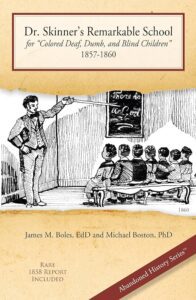
This inspired me to investigate the Black Deaf Canadian experience during the 19th and 20th centuries. For example, the evidence suggests that some of the Black Deaf Canadians were sent to the United States for education. In 1857, Dr. Platt Henry Skinner operated a school for Black Deaf and Blind students in Niagara Falls, U.S.(2011), raising a critical question: Why were Black Deaf Canadians sent to the U.S. during a dangerous period marked by slavery and racial oppression? Why were they not admitted to Canadian Deaf Schools despite the existence of institutions such as Catholic schools for the deaf established in Quebec in 1848 (for boys) and 1851 (for girls), the Ontario Deaf school established in 1851, and the Nova Scotia Deaf school established in 1856?
I am particularly curious about whether any Black Deaf students attended these Canadian schools in the 19th century. Who were they? What were their experiences, and what paths did their lives take after completing their education? Did they become scholars, activists, or community leaders, similar to their counterparts in the United States?
This research is challenging due to the scarcity of historical records, compounded by the systemic erasure of Deaf histories and the even greater invisibility of Black Deaf narratives. My goal is to reconstruct these stories, working with limited resources to piece together the lives and contributions of Black Deaf individuals in Canada. By doing so, I hope to create meaningful narratives that honour their resilience and shed light on their overlooked histories.
Exploring Deaf History in Canada
Whew! The autumn semester has elapsed rapidly since the last blog entry on the Mellon Foundation Fellowship within the Deaf Studies department. As stated in the prior blog, I lacked an understanding of the Canadian historical context and resented my upbringing in that country.

Illuminating the Untold: Black Deaf History in Canada
My journey into Black Deaf Canadian history revealed a significant gap in knowledge. By exploring the intersection of Black and Deaf identities, I aim to uncover overlooked stories and contribute to a more inclusive historical narrative. #BlackDeafHistory #CanadianHistory