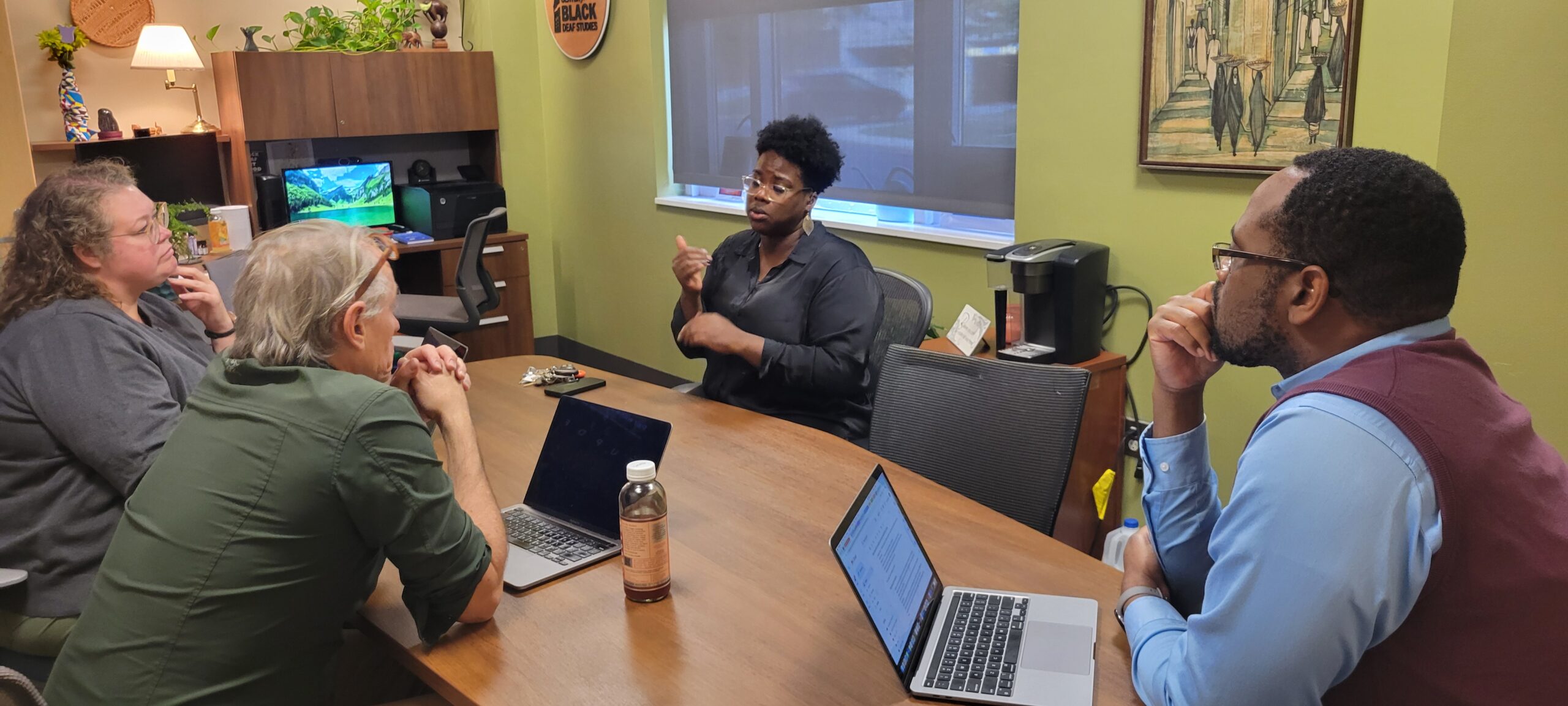
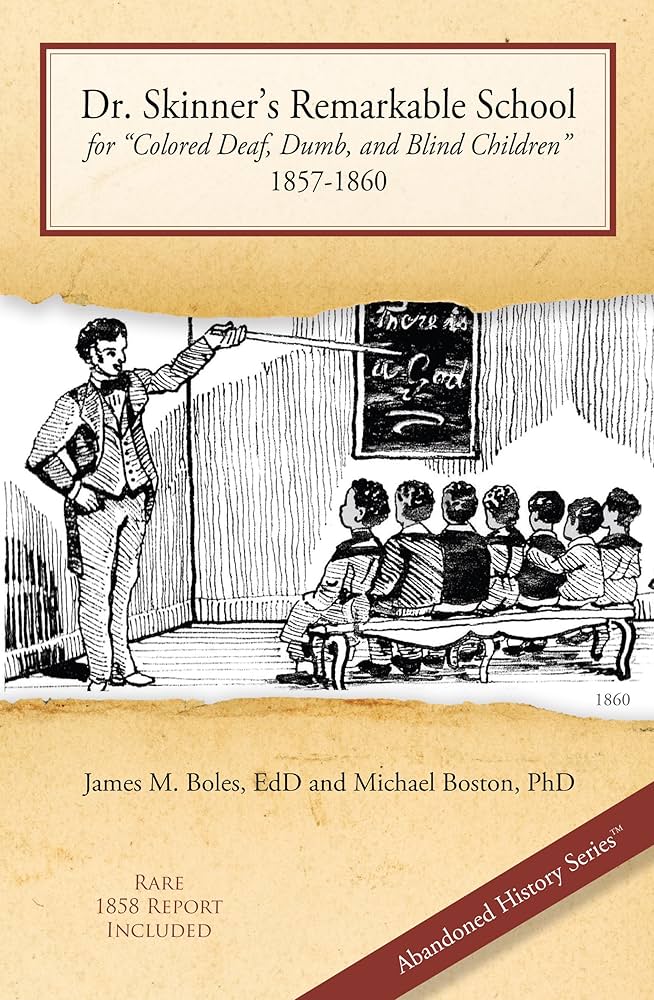
Whew! The autumn semester has elapsed rapidly since the last blog entry on the Mellon Foundation Fellowship within the Deaf Studies department. As stated in the prior blog, I lacked an understanding of the Canadian historical context and resented my upbringing in that country. Initially, I sought to understand the identity of Black Deaf Canadians in the 19th century. Following the completion of the Deaf Studies Special Topic course, Black Deaf History 1818-1890, instructed by Lindsay Dunn at Gallaudet University in the spring of 2021. Lindsay Dunn identified numerous Black Deaf individuals from the 19th century who were pioneers of their day. Yet, their contributions have been obscured in the narratives of the Black (hearing) community, the Deaf community, and American history. It was excluded from the K-12 educational curriculum and higher education institutions. Upon learning about it, I experienced the revelation that there existed Black Deaf individuals resembling us in the 19th century, which instilled a sense of pride among us as Black Deaf people. I discovered proof in the book titled Dr. Skinner’s Remarkable School for “Coloured Deaf, Dumb, and Blind Children” 1857-1860 (Boles & Boston, 2011), which revealed that five Black Deaf children from Canada attended Dr. Platt Skinner’s school. This motivated me to investigate the specific locations of their birth in Canada and the reasons why five Black Deaf children must pursue their education in the United States rather than in Canada. Was there a deaf school in Canada during the 1800s when the first permanent deaf institution in America, the Connecticut Asylum for the Education and Instruction of Deaf and Dumb Persons, was established on April 15, 1817, in Hartford, Connecticut (Crowley, n.d.)?
This signifies the initiation of my investigation into Canada’s Deaf History, recognizing that obtaining information on this subject is somewhat challenging, other from referencing Deaf Heritage in Canada (Carbin, 1996). The book Deaf Heritage in Canada, is the only resource where I can find numerous references to the history of Deaf Canada. As a Deaf Canadian growing up, I lacked awareness of Deaf Canadian history. When I graduated high school, I remembered seeing a substantial blue book featuring a maple leaf on the cover, containing photographs of persons and a manual alphabet exceeding over 600 pages. I flipped through the pages in expectation of discovering something visually stimulating, but to my dismay, nothing captured my attention. Years later, as a Mellon Foundation Fellow, I must revisit the book to explore Deaf Heritage in Canada (Carbin, 1996) for a more profound comprehension of Canadian Deaf history and culture. My historian mentors recommend scrutinizing the references list to identify the sources from which the author obtains the historical facts in the book emphasizing that historians frequently interpret information through their own lenses. It does not indicate accuracy, as there is the possibility for debate or challenge of the information from other perspectives. The first action I took was to create timelines of deaf schools founded in Canada, as this is an essential aspect of my investigation to identifying Black Deaf Canadians and the institutions they attended. The first permanent institution for the deaf in Canada was the Institution Catholique Des Sourds-Muets (Catholic Institution for Deaf and Dumb) for Boys, founded in 1848 in Montréal, Quebec (Carbin, 1996). The institution was managed by the francophone Catholic Church, and three years later, in 1851, the Institution Catholique Des Sourds-Muets for Girls was founded. Meanwhile, in 1856, the Institution for the Deaf and Dumb in Halifax was established on August 4, and in 1858, and the Upper Canada Institution for the Instruction of the Deaf and Dumb (UCIDD) began operations in Toronto on June 22, 1858 (Carbin, 1996).
The phrase “Upper Canada” denoted the region now known as Ontario prior to 1841, when it merged with Lower Canada (Quebec) to create the Province of Canada. In the 19th century, Canada was not yet the fully unified country we know today. In 1867, the Dominion of Canada under Confederation only four provinces: Ontario, Quebec, New Brunswick, and Nova Scotia. Prince Edward Island joined in 1873, followed by Newfoundland in 1949. During much of the 19th century, what is now Manitoba, Alberta, Saskatchewan, and British Columbia was not yet part of Canada, while Newfoundland remained a British colony until the mid-20th century.
The Upper Canada institution was founded in 1858, one year after Dr. Skinner’s school in Suspension Bridge, today known as Niagara Falls, which was established in 1857 (Boles & Boston, 2011). This prompts me to ask if five Black Dea students have enrolled at UCIDD. I performed genealogy research on all five pupils to determine their lives after education. Faced difficulties in monitoring them through the US and Canada census after 1860 due to complications in cross-referencing the two databases. There are notable distinctions between the US and Canadian censuses. The US census inquires information regarding an individual’s name, age, gender, race, profession/occupation, property value, birthplace, marital status, educational attendance, literacy, and whether the individual is deaf, mute, blind, insane, intellectually disabled, impoverished, or incarcerated. The 1851 Canadian census documented individuals by their first name, last name, place of birth, religion, age, and gender; however, it omitted details on race or disability, which are essential for future research to verify identity for later censuses. In contrast, the 1861 census provides more comprehensive information on race and disability, similar to the US census. This complicates my information search, prompting me to seek alternative methods of inquiry.
In my research to uncover the names of Black Deaf individuals in Ontario, I focus on the 19th century. I continued to scrutinize all the references given in Deaf Heritage in Canada to get further information, including the timeline of school establishments in Canada, school newspapers, and deaf clubs/organizations. In the process of collecting timelines, the names of school newspapers in each province, and Canadian deaf clubs/organizations, I performed a Google search concerning the author, Dr. Clifton F. Carbin. I found his website, cliftonfcarbin.ca, which showcases an impressive curriculum vitae encompassing both academic and publication achievements. A mentor from the History department was acquainted with Dr. Clifton F. Carbin and successfully facilitated my introduction to him. This led to a fruitful discussion in which Dr. Carbin offered insights and more materials for my research on the history of deaf education in Canada. This link enabled the examination of primary materials and improved understanding of the topic. Stay tuned with me to discover more about the fascinating deaf history in Canada. You won’t want to miss it!